
The transition of recreational aquatic facilities from winter cryogenic dormancy to spring functional restoration represents a high-stakes intersection of microbiology, thermodynamics, and chemical engineering. In temperate climates, particularly the Great Lakes region and Ontario, the timing of the spring pool opening is frequently a matter of cultural tradition rather than scientific prudence.1 However, the phenomenon colloquially known as the “Green Pool” surprise—a sudden and aggressive bloom of algae upon the removal of the winter cover—is a direct consequence of failing to synchronize mechanical activation with local bioclimatic indicators.3 This report provides an exhaustive analysis of the mechanisms driving spring pool degradation and establishes a comprehensive framework for timing the opening to ensure water clarity, equipment longevity, and economic efficiency.
The Microbiological Underpinnings of the Vernal Transition
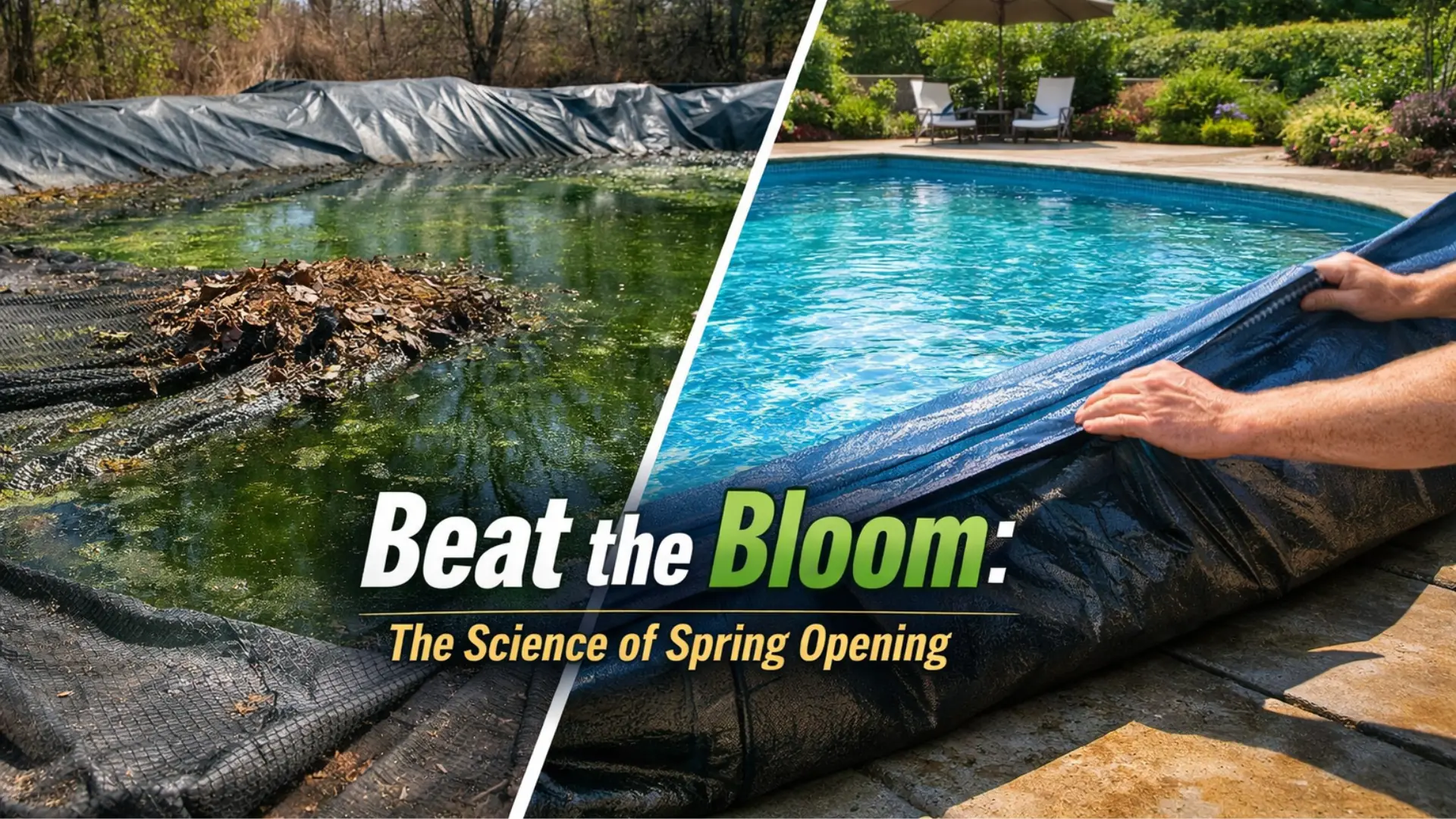
The primary antagonist in the spring pool narrative is the rapid proliferation of various algal species, primarily members of the Chlorophyta division. These microscopic aquatic organisms are not dormant in the traditional sense; rather, their metabolic and reproductive cycles are suppressed by the low winter temperatures.5 As solar radiation increases and the thermal mass of the pool water begins to absorb energy, these organisms enter a phase of exponential growth that can transform clear water into an opaque, high-viscosity biological soup within a matter of days.7
Algal Taxonomy and Environmental Triggers
Algae spores are ubiquitous in the atmosphere, introduced into the pool environment via wind, precipitation, and organic debris that penetrates the winter cover.3 In the context of a spring opening, the most common varieties encountered are green algae, mustard algae, and, in cases of extreme neglect, black algae.8 Green algae are characterized by their rapid cell division and ability to float freely in the water column, whereas mustard (yellow) algae exhibit higher resistance to standard chlorine concentrations and tend to adhere to pool surfaces in shaded areas.8
The availability of light and nutrients governs the activation of these spores. Even under opaque covers, a degree of UV penetration is often present, particularly with mesh safety covers, which may allow up to $5\%$ of sunlight to reach the water surface.10 This light provides the energy for photosynthesis, a process where algae consume dissolved carbon dioxide ($CO_2$) and expel oxygen ($O_2$) as a byproduct.7 The chemical consequence of this metabolic activity is a rise in the water’s pH, which subsequently diminishes the effectiveness of any remaining sanitizers, creating a positive feedback loop for biological growth.7
Nutrient Accumulation and the “Tea Bag” Effect
The accumulation of nutrients throughout the winter is a critical precursor to the spring bloom. Organic matter, such as leaves, pine needles, and pollen, collects on the surface of the pool cover. As spring rains and snowmelt saturate this debris, a concentrated leachate of phosphates and nitrates—the primary limiting nutrients for algal growth—percolates through the cover or enters through gaps at the perimeter.3 This phenomenon, often termed the “tea bag” effect, transforms the stagnant water under the cover into a nutrient-rich culture medium.6
| Nutrient Component | Environmental Source | Impact on Spring Water Quality |
| Orthophosphates | Fertilizers, decaying leaves, atmospheric dust | Fuels rapid algal cell wall synthesis and division.3 |
| Nitrates | Rainwater, organic decomposition | Acts as a primary nitrogen source for protein production.3 |
| Dissolved Solids | Winter salt, road dust, concrete leaching | Increases conductivity and can interfere with chemical sensors.7 |
| Organic Carbon | Pollen, insects, surface runoff | Creates a high chlorine demand, neutralizing sanitizers.11 |
The presence of these nutrients means that once the water temperature crosses a certain threshold, the pool is chemically primed for an outbreak. Research indicates that when phosphate levels exceed $100\text{ ppb}$ (parts per billion), the efficacy of standard chlorine treatments is severely compromised, as the rate of algal reproduction can outpace the rate of sanitization.8
The Thermodynamics of the Pool Cover Greenhouse Effect
A significant factor in the “Green Pool” surprise is the disparity between ambient air temperature and the temperature of the water directly beneath the pool cover. The winter cover, whether solid or mesh, acts as a thermal collector. In the presence of direct sunlight, the cover absorbs infrared radiation and transfers this thermal energy to the stagnant water surface through conduction and convection.6
Thermal Stratification in Stagnant Water
During the early spring, pool water often undergoes significant thermal stratification. The upper six inches of water can be as much as $10^\circ C$ to $15^\circ C$ warmer than the water at the bottom of the deep end.5 This warm surface layer is where the majority of algal activity occurs. Because the pool’s circulation system is inactive during the winter, there is no mechanical mixing to distribute colder, more stable water from the depths. Consequently, the surface layer can reach temperatures conducive to rapid biological growth even while the rest of the pool remains near freezing.5
The 15°C (60°F) Biological Threshold
The consensus among aquatic professionals is that $15^\circ C$ ($60^\circ F$) represents the critical threshold for spring maintenance. Below this temperature, the metabolic rates of most pool pathogens and algae are sufficiently suppressed to allow for a clean opening.5 Once the water temperature consistently exceeds this mark, the protective window closes rapidly.
Opening the pool when the water is still cold—ideally between $7^\circ C$ and $12^\circ C$—ensures that the filtration system can remove the winter’s accumulated silt and debris before it becomes incorporated into a living algal colony.9 The thermal mass of the pool means that water temperatures lag behind air temperatures, but the greenhouse effect under the cover can accelerate this warming beyond what local weather forecasts might suggest.1
Climatological Analysis of the Great Lakes Basin and Ontario
For pool owners in Ontario and the surrounding regions, timing the opening requires a nuanced understanding of the local climate, specifically the transition from the last hard frost to the consistent warming of late spring.
Frost Dates and Mechanical Vulnerability
The primary risk associated with an early opening is the potential for mechanical failure due to freezing. If the pool’s plumbing and filtration equipment are filled with water and an unseasonable cold snap occurs, the expansion of freezing water can crack PVC pipes, filter housings, and expensive heater manifolds.1
In Southern Ontario, including the Greater Toronto Area (GTA), the average last frost occurs between late April and early May.19 However, localized microclimates can vary significantly.
| Ontario Location | Average Last Spring Frost | Recommended Opening Window |
| Toronto / GTA | April 25 – May 4 | Late April.1 |
| Niagara Region | Mid-April | Mid-April.21 |
| Ottawa / Eastern Ontario | May 9 – May 17 | Mid-May.19 |
| Barrie / Simcoe County | May 11 – May 20 | Mid-May.16 |
| Kingston / St. Lawrence | May 1 – May 10 | Early May.21 |
The optimal strategy is to monitor the 14-day forecast for a consistent trend where overnight lows remain above $0^\circ C$. Most modern pool equipment can withstand a brief, “light” frost (e.g., $-1^\circ C$ for a few hours) if the pump is kept running to maintain water movement.5 However, a “hard” frost (below $-2^\circ C$ for extended periods) necessitates that the system remain winterized.1
The Fallacy of the Victoria Day Tradition
In Canada, the Victoria Day long weekend in late May is the traditional “target” for pool openings.1 While this date is convenient for social planning, it is often two to four weeks too late from a biological perspective. By mid-May, the cumulative solar gain under the cover has typically pushed water temperatures well into the $20^\circ C$ ($68^\circ F$) range, essentially guaranteeing an algae bloom.1
Homeowners who adhere strictly to the late-May schedule frequently face higher costs for shock treatments and more hours of labor spent scrubbing surfaces and backwashing filters.4 The shift toward earlier openings—targeting mid-April to early May—is a proactive measure to “beat the heat” and ensure the pool is ready for use the moment ambient temperatures become comfortable for swimming.1
Chemical Dynamics of the Spring Startup
The chemistry of a pool upon opening is fundamentally different from its chemistry during mid-season operation. The water has likely undergone significant dilution from rain and snow, and the depletion of sanitizers has left the environment vulnerable.
The pH-Chlorine Efficacy Relationship
Chlorine’s ability to kill algae is directly tied to the pH of the water. When chlorine is added to water, it forms hypochlorous acid ($HOCl$), the active killing agent, and hypochlorite ions ($OCl^-$), which are much slower to react. The ratio of $HOCl$ to $OCl^-$ is determined by the pH level.
$$Cl_2 + H_2O \rightleftharpoons HOCl + HCl$$
At a pH of 7.2, approximately $65\%$ of the chlorine is in the active $HOCl$ form. At a pH of 8.0, that figure drops to less than $25\%$.3 Spring pools often exhibit high pH levels due to the lack of aeration and the presence of alkaline debris or algal metabolism.7 Failure to lower the pH before adding shock treatment is a common mistake that renders the chemical intervention largely ineffective.8
Managing Cyanuric Acid and Chlorine Lock
Cyanuric acid (CYA) is used as a stabilizer to protect chlorine from degradation by UV rays. However, CYA does not dissipate; it only increases with the continued use of stabilized chlorine pucks (Trichlor).3 If CYA levels are too high ($>80\text{ ppm}$), it creates a “chlorine lock” where the chlorine is bound so tightly to the stabilizer that it cannot sanitize the water.3
In the spring, it is vital to test CYA levels immediately. If they are excessive, the only solution is a partial drain and refill with fresh water.3 This is best performed early in the season when water costs may be lower and the risk of ground-heave (from high water tables) is manageable by professionals.9
Total Alkalinity as a pH Buffer
Total Alkalinity (TA) measures the water’s ability to resist changes in pH. During the winter, TA can fluctuate due to the ingress of acidic rainwater or snowmelt.3 If TA is too low, the pH will “bounce” wildly, making it impossible to stabilize the water for a clean opening. Conversely, high TA can cause persistent high pH and scaling.3
| Chemical Parameter | Ideal Opening Range | Role in Spring Maintenance |
| pH | $7.2 – 7.4$ | Maximizes chlorine reactivity for the initial shock.7 |
| Free Chlorine | $10 – 20\text{ ppm}$ (Initial Shock) | Eliminates dormant spores and organic contaminants.8 |
| Total Alkalinity | $80 – 120\text{ ppm}$ | Stabilizes pH and protects equipment from corrosion.3 |
| Calcium Hardness | $200 – 400\text{ ppm}$ | Prevents leaching from plaster and concrete surfaces.9 |
| Cyanuric Acid | $30 – 50\text{ ppm}$ | Protects chlorine from sun while avoiding “lock”.3 |
Operational Protocols for Professional Pool Restoration
The physical process of opening a pool requires a systematic approach to prevent secondary contamination and ensure mechanical integrity.
Cover Management and Secondary Contamination
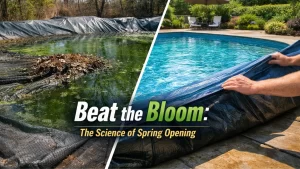
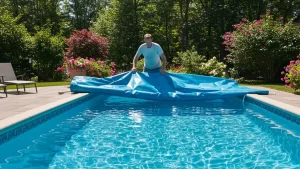
The removal of the winter cover is the moment of greatest risk for the pool’s clarity. If the cover is pulled back without being properly cleaned and drained, several gallons of hyper-concentrated organic sludge may be dumped into the pool.1
- Water Evacuation: All standing water must be pumped off the cover using a submersible pump.9
- Debris Removal: Solid debris should be swept or blown off the cover before it is moved.1
- Clean and Dry: Once removed, the cover should be scrubbed with a specialized cover cleaner or a mild soap solution, allowed to air dry completely to prevent mold and mildew, and then stored in a rodent-proof container.16
Equipment Inspection and Winter Damage Assessment
The harsh Canadian winter can wreak havoc on pool structures and mechanical systems. A thorough inspection must be conducted before the pump is primed and activated.1
- Liner and Surface Integrity: Inspect for tears in vinyl liners, “heaving” of concrete decks, or cracks in tile and grout.18
- Plumbing and Fittings: Ensure all winterizing plugs are removed from skimmers and return lines. Reinstall directional eyeball fittings and check for any cracks in the plastic housing.30
- Pump and Filtration: Check the pump basket and lid gasket for dry rot. Lubricate O-rings with a silicone-based lubricant to ensure an airtight seal. Inspect the filter media (sand, DE, or cartridge) for signs of fouling or damage.11
- Heater Safety: If the pool is equipped with a gas heater, the burner tray and heat exchanger should be checked for debris or rodent nests, which can pose a fire hazard upon ignition.9
The Priming and Startup Sequence
Once the equipment is inspected and the water level is restored to the midpoint of the skimmer opening, the circulation system can be engaged.1
- Fill the Pump Basket: Water must be manually added to the pump housing to facilitate priming. Running a centrifugal pump dry can damage the mechanical shaft seal within seconds.11
- Multiport Valve Setting: The filter should initially be set to the “Waste” or “Drain” position if significant silt is present on the bottom, or “Filter” if the water is relatively clear.32
- Continuous Circulation: For the first 24 to 48 hours after opening, the filtration system should run continuously to ensure complete turnover and distribution of opening chemicals.7
Economic Assessment of Spring Opening Strategies
There is a pervasive belief among homeowners that delaying the pool opening saves money on electricity and chemicals.4 An objective financial analysis, however, proves the opposite: the cost of remediating an algae-infested pool far outweighs the operational costs of an early opening.
Remediation Costs vs. Preventative Maintenance
A “Green Pool” requires what is known in the industry as a “Bomb” treatment—aggressive chemical intervention involving multiple doses of high-strength chlorine, flocculants, and algaecides.9
| Service Component | Early Opening Cost (CAD) | Late Opening (Remediation) Cost (CAD) |
| Opening Chemical Kit | $\$50 – \$150$ | $$200 – $\$450$.9 |
| Professional Labor | $\$250 – \$350$ (Standard) | $$500 – $\$1,000$ (Deep Clean).9 |
| Filtration Electricity | Negligible (Standard Run) | High (24/7 Run for 5-7 days).7 |
| Filter Media Wear | Minimal | High (Requires replacement or deep soak).3 |
| Total Estimated Expense | $$300 – $\$500$ | $$700 – $\$1,500+$ |
Opening the pool in April, when the water is cold, allows the owner to maintain the water with a standard chlorine residual of $1-3\text{ ppm}$.8 In contrast, waiting until June to find a “pea soup” pool may require maintaining levels above $30\text{ ppm}$ for several days to successfully kill the algae, followed by hours of vacuuming dead algae to waste, which also incurs additional water and heating costs.7
Professional Availability and Service Premiums
In the pool industry, the period from May 15 to June 15 is known as the “seasonal rush.” During this window, reputable service companies are often booked to capacity, and emergency service calls can command significant premiums.26 Opening in late April or early May not only avoids these surcharges but also ensures that if a major component (like a pump motor or heater) has failed over the winter, there is ample time to source parts and complete repairs before the peak swimming season begins.1
SEO and Digital Strategy for the Pool Service Industry (2025-2026)
For businesses providing pool opening services, the spring transition is a peak period for digital acquisition. Success in this market requires a sophisticated approach to search engine optimization (SEO) that targets high-intent, localized queries.
Search Intent and Keyword Mapping
The modern consumer’s journey for pool services begins with informational searches that transition into transactional intent as the weather warms. Content strategy must mirror this journey.37
- Informational Intent: “Why is my pool green?” or “When to open pool in Ontario”.38
- Commercial Intent: “Best pool opening service Toronto” or “Reviews for pool companies in Mississauga”.38
- Transactional Intent: “Book pool opening service” or “Cost of pool opening Ottawa”.9
Technical SEO and Meta-Data Optimization
In 2025, Google’s algorithms increasingly prioritize E-E-A-T (Experience, Expertise, Authoritativeness, and Trustworthiness).37 To rank for competitive vernal queries, websites must be technically optimized for speed and clarity.
- Header Tags: Use a single H1 tag that incorporates the primary keyword and location (e.g., <h1>Expert Pool Opening Services in the GTA</h1>). Follow this with H2 and H3 tags that provide clear, structured answers to “People Also Ask” (PAA) questions.42
- Meta Descriptions: These should act as a concise call-to-action (CTA), promising a specific outcome like “Crystal clear water” or “Same-day service” within the $120-155$ character limit to avoid truncation.37
- Structured Data (Schema): Implementing LocalBusiness and FAQ schema allows Google to display rich snippets, such as star ratings and direct answers to pricing questions, directly on the search results page, significantly increasing the click-through rate (CTR).37
Content Freshness and Regional Relevance
Search engines favor content that is updated to reflect the current year and local conditions.43 A blog post titled “Pool Opening Tips for 2025” will outperform a generic post from 2020. Furthermore, including region-specific details—such as mentioning the “Victoria Day” weekend or specific Ontario frost trends—signals to the algorithm that the content is highly relevant to local users.1
Strategic Mitigations for Early-Season Hazards
While earlier openings are generally superior, they do introduce specific challenges that require professional mitigation strategies.
Managing the Vernal Pollen Load
The heavy pollen drop from coniferous and deciduous trees in early May can be overwhelming for filtration systems. This organic material is a potent source of food for algae and can quickly foul filter cartridges or cause “pressure spikes” in sand filters.9
- Skimmer Socks: Using ultra-fine skimmer socks can capture the majority of pollen before it enters the main filtration system.11
- Enzymatic Treatments: Adding specialized pool enzymes during the first month can help break down non-living organic waste like pollen and bather oils, reducing the chlorine demand and preventing the formation of a “scum line”.6
Stabilizing the Variable Water Table
In many parts of Ontario, the spring thaw and heavy rains lead to a high water table. If a pool is drained for cleaning or liner repair during this time, there is a risk of “floating” the liner or, in extreme cases, the entire pool structure popping out of the ground.29
Professional pool technicians monitor groundwater levels and utilize hydrostatic relief valves or temporary sump-pumps to mitigate this risk. DIY owners are strongly cautioned against significant draining during the spring months without a professional assessment of local groundwater conditions.9
Final Synthesis and Strategic Recommendations
The transition of a swimming pool from its winter state to a summer-ready facility is a process governed by the immutable laws of chemistry and biology. The “Green Pool” surprise is not an act of God, but a predictable consequence of timing. By shifting the paradigm from a calendar-based tradition to a weather-based scientific approach, facility managers and homeowners can ensure superior water quality and significant cost savings.